The Zebrafish Atlas Phenotype Project (ZAPP) is a community driven effort focused on standardizing zebrafish toxicology data and phenotypic outcome reporting. ZAPP's success depends on active participation from the zebrafish research and toxicology community to ensure that ZAPP remains fit for purpose, sustainable, and effective in improving the integration and reuse of toxicological and phenotypic data.
What ZAPP Aims to Achieve
- Develop a data model and standards to report zebrafish exposure experiments and resulting phenotypes.
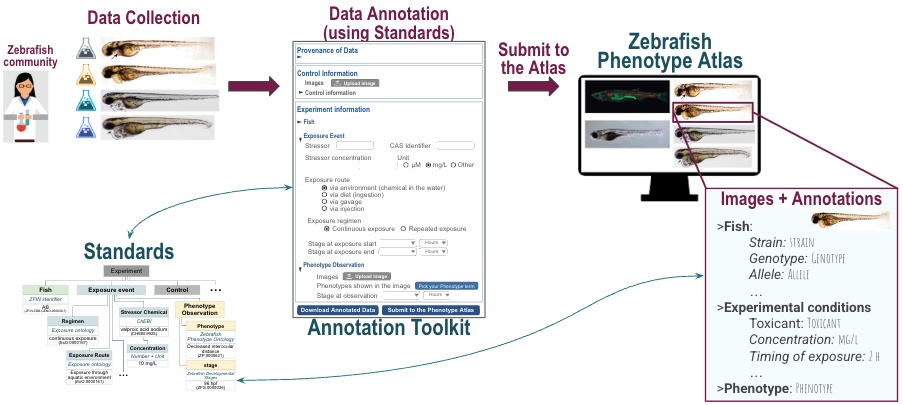
- Create an annotation toolkit that enables consistent data annotation following the data model and standards. This annotation toolkit will allow standards adoption without prior knowledge of ontologies or data modeling.
- Build a web-based, community-curated phenotype atlas that serves as a visual reference for zebrafish phenotypes.
ZAPP Workflow & Data Pipeline
Key Deliverables
Our project focuses on three major deliverables that will transform zebrafish toxicology research
Data Model and Standards for Toxicological and Phenotypic data
We are creating a LinkML-based data model, based on existing toxicological data structures to support comprehensive representation of toxicological exposures, including time course, toxicants, concentrations, fish information, and phenotypic endpoints. The LinkML schema is developed with community input across multiple toxicology use cases and designed for use across organisms. More information about the data model can be found here.
In addition, we improve standards to represent all data, including (but not limited to):
- The Zebrafish Phenotype Ontology (ZP) — to represent zebrafish phenotypes
- The Environmental conditions, treatments and exposures ontology (ECTO) — to represent exposure and exposure description (e.g. route and regimen) terms
Annotation Toolkit for Toxicological and Phenotypic data
We aim to develop a community-driven annotation toolkit aligned with the data model to support standardized data annotation for toxicological exposures and resulting phenotypes, and submission to the ZAPP Atlas.
Tutorials and curation guidelines will be provided to ensure consistent annotation across contributors.
Phenotype Atlas Web application
We will collect images and standardized metadata of morphological phenotypes from toxicology studies using the annotation toolkit. These data will instantiate a zebrafish phenotype atlas and provide visual standards for phenotypes.
The open source web-based phenotype atlas will support exploration and querying of exposures and phenotypes, display representative images and link to relevant external resources.
FAIR API access to the data will be provided for third-party resources.
Contribute Data
Submit your zebrafish toxicology data and phenotype observations to help build the atlas.
Get Involved ›Upcoming Workshops
Join our workshops to learn about data annotation standards and contribute to the community.
View Workshops ›